

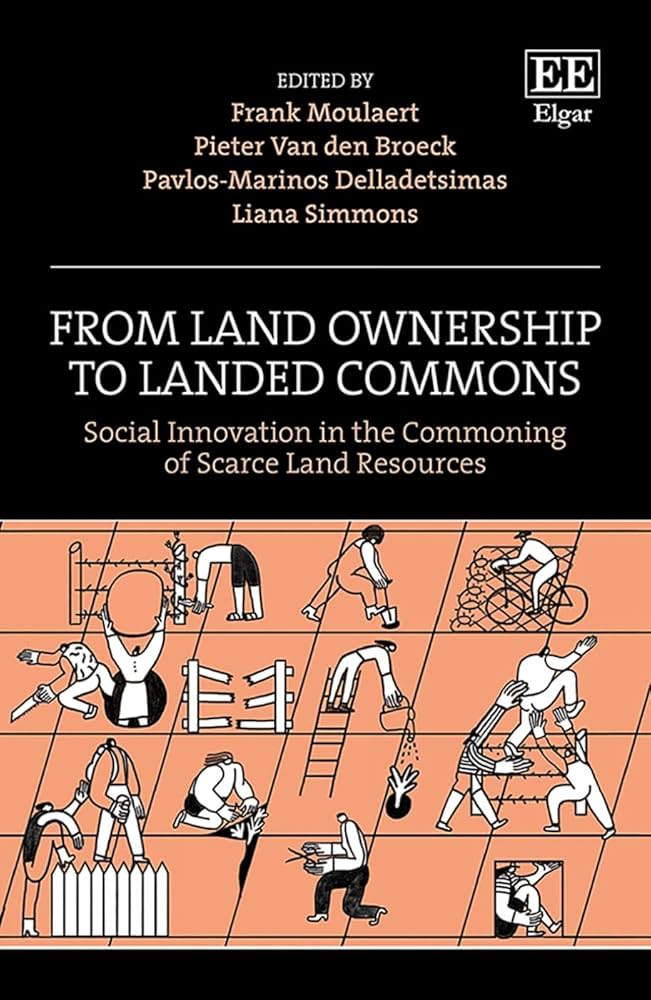
At EMES, we are always happy to support our members by sharing their news, publications and initiatives with the community and beyond. Even more so when these contributions bring new ideas, reflections and inspiration for collective thinking. This time, we are delighted to highlight a new book connected to someone very dear to the EMES community and widely respected in the field — Frank Moulaert, whose work has long inspired many of us through its depth, critical perspective and visionary thinking.
The book, From Land Ownership to Landed Commons: Social Innovation in the Commoning of Scarce Land Resources, is edited by Frank Moulaert together with colleagues Pieter Van den Broeck, Pavlos-Marinos Delladetsimas and Liana Simmons. The volume brings together rich reflections on commons, commoning and social innovation, offering insights that resonate strongly with many of the debates and values shared within the EMES community.
The book explores how societies organise access to land and how collective practices of commoning can help address contemporary social and ecological challenges. Bringing together international perspectives, the volume reflects on the role of social innovation, solidarity and collective governance in the management of scarce land resources.
Understanding Landed Commons
The book pursues three ambitions. First, it explores the trajectory of thought and, to some extent, the practice of Landed Commons – land used collectively and governed through shared practices.
Second, it develops and experiments with a methodology of Socially Innovative Action Research, designed to support processes of commoning and the development of commons-based initiatives.
Third, the book emphasises that commoning is fundamentally about social relations. It is not only about working together to manage resources, but also about being together through relations of empathy, mutual aid, reciprocity and even post-human relations with nature.
Commoning, Social Innovation and the Social and Solidarity Economy
The book also contributes to ongoing debates between social innovation (SI) and the social and solidarity economy (SEE).
As Frank Moulaert explains, SEE literature has sometimes criticised social innovation for being insufficiently economic or practical, while social innovation scholars have argued that SEE approaches may underestimate the importance of social relations in building collective initiatives and communities.
From a social innovation perspective, initiatives go beyond economic organisations. They can include cultural circles, emancipation movements, peer groups, education support networks or communal gardening initiatives, whose success depends largely on the strength and solidarity of social relations among participants.
Commoning and commons-based practices go even further. They aim to create shared resources through collective practices, placing social relations and collective responsibility at the centre of governance.
The “Anesthesia of the Social”
A central reflection in the book concerns what Moulaert calls the “anesthesia of the social.”
Since the early twentieth century, the concept of innovation has increasingly been associated with technological and economic change, overshadowing its earlier meaning linked to social transformation.
Social innovation re-emerged in the 1970s as a response to the growing dominance of technocratic models of development. Today, however, its role has become even more complex.
In the context of socio-ecological transitions, public debate often focuses on protecting the planet and biodiversity, sometimes leaving aside the human dimension of solidarity and social relations.
As Moulaert argues:
“To save the world, we must rebuild solidarity.”
These reflections resonate strongly with the long-standing research of the EMES Network, which explores how social innovation and the social and solidarity economy contribute to building more inclusive, cooperative and sustainable societies.
By connecting the concepts of commons, commoning and social innovation, this book offers valuable insights for scholars, practitioners and communities interested in alternative forms of governance and collective action.
Book information
From Land Ownership to Landed Commons: Social Innovation in the Commoning of Scarce Land Resources
Edited by Frank Moulaert, Pieter Van den Broeck, Pavlos-Marinos Delladetsimas and Liana Simmons
Edward Elgar Publishing
Learn more about the book:
https://www.e-elgar.com/shop/gbp/from-land-ownership-to-landed-commons-9781035319671.html